
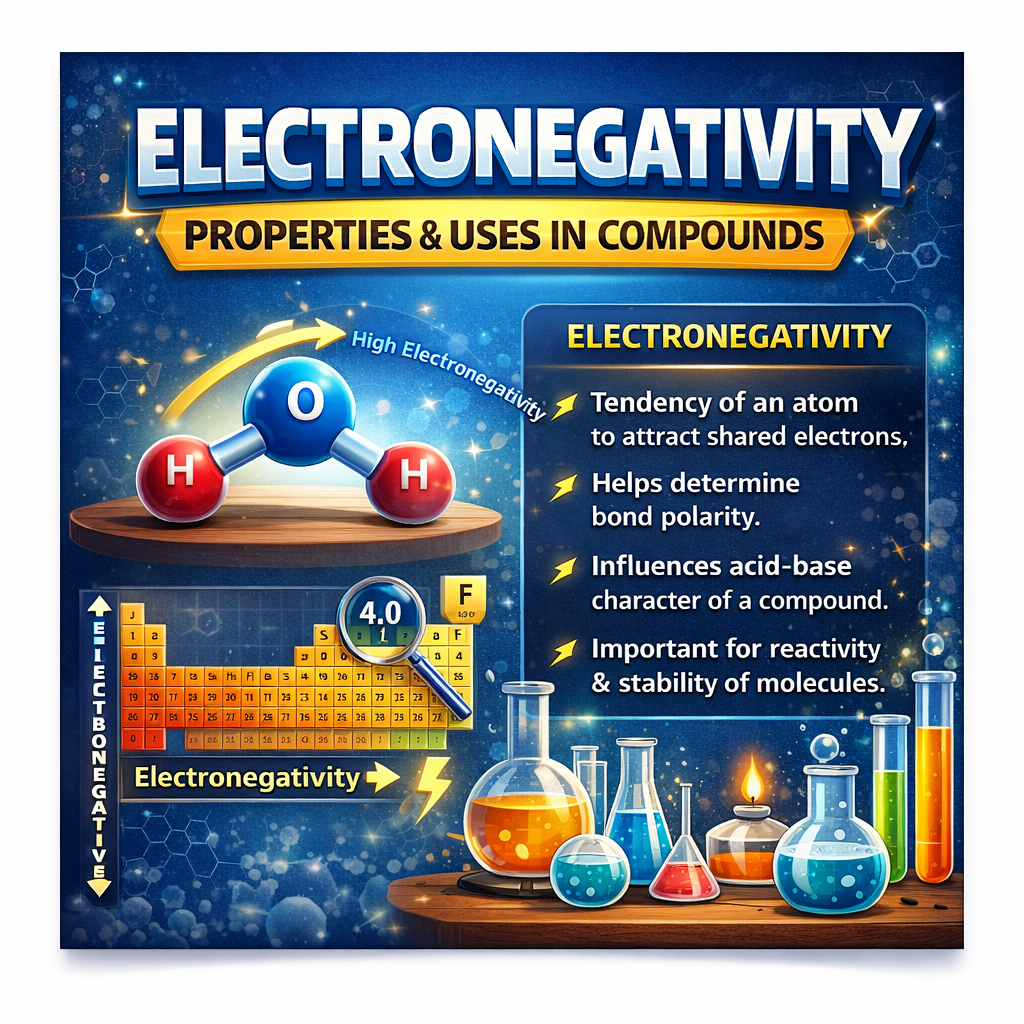
⚡ Electronegativity – Complete Concept
📌 1️⃣ Definition
Electronegativity is the tendency of an atom in a molecule to attract the shared pair of electrons toward itself.
👉 It is not for isolated atoms, only for atoms in a bond.
📊 2️⃣ Important Scales
- Pauling Scale (most used in JEE)
- Fluorine (F) = 4.0 (highest)
- Other scales:
- Mulliken
- Allred-Rochow
🔥 3️⃣ Key Characteristics
- No unit (dimensionless quantity)
- Depends on:
- Atomic size
- Nuclear charge
- Hybridization
- Oxidation state
📈 4️⃣ Periodic Trends
Across a Period (→)
- Increases
- Reason: Increase in nuclear charge
Down a Group (↓)
- Decreases
- Reason: Increase in atomic size
⚠️ 5️⃣ Important Exceptions / Special Cases
- Noble gases → usually no electronegativity (inert)
- Transition metals → irregular trend
- F is highest, but Cl sometimes shows stronger bonding behavior in some compounds
🧪 6️⃣ Factors Affecting Electronegativity
🔹 1. Atomic Size
- Smaller atom → higher electronegativity
🔹 2. Effective Nuclear Charge
- Higher charge → stronger attraction
🔹 3. Hybridization
sp>sp2>sp3sp > sp^2 > sp^3
👉 Example:
- C (sp) > C (sp²) > C (sp³)
🔹 4. Oxidation State
- Higher oxidation state → higher electronegativity
🧬 7️⃣ Applications in Compounds (Very Important)
🔹 1. Bond Type Prediction
Difference in electronegativity (ΔEN):
| ΔEN | Bond Type |
|---|---|
| 0 | Non-polar covalent |
| 0–1.7 | Polar covalent |
| >1.7 | Ionic |
👉 Example:
- H₂ → non-polar
- HCl → polar
- NaCl → ionic
🔹 2. Bond Polarity
- Higher EN difference → higher polarity
👉 Example:
- O–H bond is polar
- C–H bond is almost non-polar
🔹 3. Dipole Moment
- Electronegativity determines direction of dipole
👉 Example:
- In HCl → Cl is δ⁻, H is δ⁺
🔹 4. Acidic and Basic Nature
- High electronegativity → acidic character increases
👉 Example:
- CH₄ < NH₃ < H₂O < HF (acidity increases)
🔹 5. Inductive Effect (Organic Chemistry)
- Electron-withdrawing groups (-I effect) depend on EN
👉 Example:
- -NO₂, -Cl → strong -I effect
🔹 6. Stability of Compounds
- Higher EN → stronger bond attraction
👉 Example:
- HF is more stable than HI
🔹 7. Reactivity of Elements
- High EN → strong oxidizing agents
👉 Example:
- F₂ is strongest oxidizing agent
🔹 8. Metallic vs Non-metallic Character
- Low EN → metallic nature
- High EN → non-metallic nature
🧠 8️⃣ Comparison with Electron Gain Enthalpy
| Property | Electronegativity | Electron Gain Enthalpy |
|---|---|---|
| Type | Relative property | Energy change |
| Applies to | Bonded atoms | Isolated atoms |
| Unit | No unit | kJ/mol |
🎯 9️⃣ JEE Important Points
- Fluorine = highest EN
- Trend questions are very common
- Hybridization effect → very important for advanced level
- Used in:
- Bond polarity
- Organic reactions
- Acid-base strength
🧩 10️⃣ Quick Memory Tricks
👉 “F is the boss of electronegativity”
👉 Across ↑, Down ↓
🚀 Final Summary
- Electronegativity controls:
- Bond type
- Polarity
- Reactivity
- Acid-base nature
- It is one of the most important concepts in chemistry

You may also like
🧪 Periodic Table of Elements – Easy Explanation for Students
March 20, 2026


Our ClassesTeaching Method by Dhruv Sir Our Classes
March 17, 2025